Introduction
A website is often where a potential customer checks whether your business looks credible, understands their problem and is easy to contact. Choosing the right web designer is therefore about more than finding someone who can make attractive pages. You need a clear working relationship, a site that fits your customers and a plan for what happens when the project goes live.
For a small business, the decision can be especially hard: proposals may vary in price, language, deliverables and ongoing costs. The right choice is not automatically the cheapest or the one with the most features. It is the provider whose approach, scope and support match what your business actually needs.
If you are already planning a project, you can see how ModernFlow approaches web design or talk through your requirements. If you are still comparing options, use the guide below before committing to anyone.
Start with what your business needs from the website
Before speaking to designers, write down what prompted the project and what a useful result would look like. A local tradesperson may need visitors to understand the service area and call quickly. A consultant may need to explain specialist work and make it easy to request an introductory conversation. A shop may need clear product information or an online checkout.
Be specific about the customer journey, not just the visual style. For example, “I need more people to understand which areas we cover and ask for a quote” gives a designer more to work with than “I want a modern website”.
A short starter brief can include:
- What you sell, who you serve and where you operate.
- The main action you want a visitor to take: call, enquire, book or buy.
- Which pages and functions are essential at launch.
- What is not working with your current site, if you have one.
- Your budget range, target launch window and who can provide content or approvals.
This gives each provider the same context, making proposals easier to compare. It also helps reveal whether they ask thoughtful questions or jump straight to a template and a price.
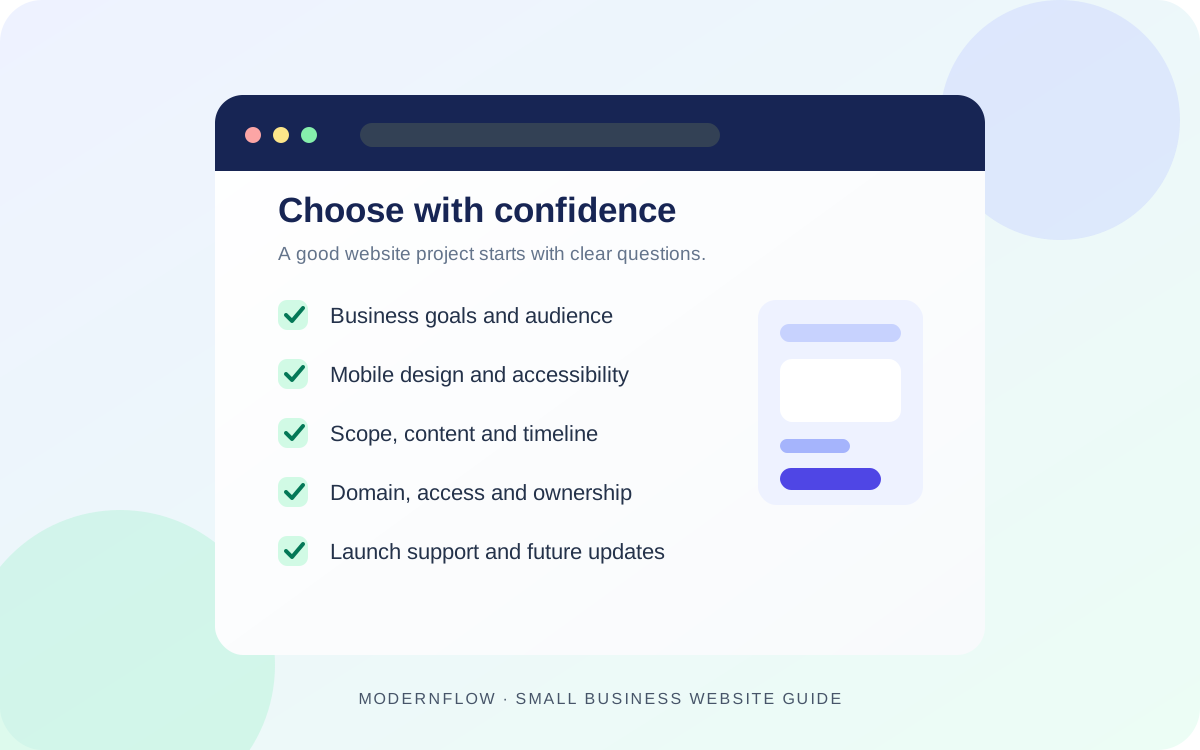
What to check before choosing a web designer
1. Relevant work and a clear explanation of the process
Review live examples, not only polished screenshots. Open the sites on a phone and try the important actions: find a service, use the navigation, tap the phone number and complete a contact form. Ask what the designer contributed and what parts were handled by the client or another supplier.
Your business does not need a designer who has worked in your exact niche. It does need someone who can explain how they would understand your customers, organise information and make the next step obvious. A portfolio of ModernFlow work is available if you want to see examples of delivered sites.
2. Mobile usability, accessibility and performance
Ask how the design will work on small screens, whether text and buttons will remain easy to use, and how images and page weight will be considered. A site can look impressive on a large monitor and still be awkward to use on a phone.
Ask what accessibility checks and launch testing are included. You do not need to expect a designer to promise a perfect score or a particular ranking; you do want them to describe practical checks for readability, contrast, keyboard access, forms and responsive layouts.
3. Search foundations, not ranking guarantees
A sound build can include descriptive page titles, useful headings, crawlable links, sensible page structure, mobile-friendly presentation and a way to add relevant content. Those foundations help search engines interpret a site, but they do not guarantee a position in Google or a fixed number of enquiries.
Ask what SEO work is included in the project and what would be a separate, ongoing service. If a provider guarantees a specific ranking or a flood of leads without understanding your market, treat the claim carefully.
4. A written scope that says what is included
The proposal should describe the pages, features, design rounds, content responsibilities, integrations, testing and launch tasks. It should also explain how additional requests are handled. “A complete website” can mean very different things to different people.
Check who writes or supplies the copy, sources images, provides domain access and approves the work. If you need booking, payments, a customer portal or a connection to another system, make that clear before the quote is finalised.
5. Ownership, access and portability
Ask who owns the domain, the website files, written copy, design assets and any accounts created for the project. Make sure your business can access its domain registrar, hosting account, analytics and relevant platform logins. The answer can depend on the contract and technical setup, so get it in writing rather than relying on assumptions.
Also ask what happens if you leave the provider. Can the site be transferred or exported? Are there platform fees or dependencies? Is there a handover charge? Clear answers now reduce the risk of an unpleasant surprise later.
6. Support and costs after launch
Find out what happens when you need to change opening hours, add a service or fix a problem. Is support included for a defined period, available through a monthly plan, or charged as needed? Ask about response expectations, what counts as a small update and which changes need a separate quote.
Some businesses prefer a one-off project and manage the site themselves; others value ongoing help and predictable support. Neither arrangement is universally better. Compare the full agreement, not just the initial build fee. ModernFlow explains its current website plan options separately, and its guide to website subscription benefits covers the trade-offs of a monthly arrangement.
Questions to ask a web designer
A useful discovery conversation should leave you clearer about the work, not pressured to sign. Consider asking:
- How will you learn about my customers and the action I want them to take?
- What exactly is included in the price, and what might cost extra?
- Who supplies the copy, images and domain, and who has final approval?
- How will the site be tested on mobile, and what launch checks do you carry out?
- What SEO foundations are included, and what is outside the scope?
- Who owns the domain, content, design assets and website access?
- What support, maintenance or updates are available after launch, and on what terms?
- What do you need from me, and what could delay the agreed schedule?
- Can I speak to a previous client or review live examples relevant to this type of project?
Pay attention to how the designer answers. Good answers are concrete, understandable and honest about limits. You should be able to explain the proposed next steps to a colleague without translating a page of jargon.
How to compare website design quotes fairly
Put proposals side by side and compare like with like. A lower quote may cover fewer pages, no copywriting, limited revisions or no support after launch. A higher quote may include work you do not need yet. Ask each provider to clarify gaps before deciding.
| Area | What to confirm |
|---|---|
| Project scope | Pages, features, integrations, revisions and exclusions. |
| Content and assets | Who writes copy, supplies images and provides approvals. |
| Technical delivery | Mobile layouts, forms, testing, launch and any migration work. |
| SEO | Specific on-page foundations included versus ongoing SEO work. |
| Ownership and access | Domain, accounts, website files, licences and exit arrangements. |
| Aftercare | Support period, update limits, maintenance and additional charges. |
| Payment and timing | Payment stages, dependencies, expected milestones and change process. |
Ask for a revised proposal if an important detail is unclear. A clear written agreement protects both sides and gives you a shared reference point if the scope changes.
Want a second opinion on your website project?
Share what your business does, what you need the site to do and any questions you have. ModernFlow can discuss the practical options without assuming every project needs the same solution.
Warning signs to take seriously
One concern does not automatically mean a designer is unsuitable, but repeated uncertainty deserves attention. Pause and ask for clarification if:
- The provider will not explain the scope, exclusions or ongoing costs in writing.
- You are promised guaranteed Google rankings, sales or enquiry numbers.
- They cannot explain who owns the domain, accounts or site after payment.
- They dismiss mobile usability, accessibility, security or testing as unimportant.
- You are pushed to decide immediately without time to read the terms.
- The proposal focuses on visual effects but says little about your customers or goals.
Trust your judgement. A good working relationship should allow reasonable questions, clear boundaries and enough information to make an informed decision.
What a sensible website design process looks like
There is no single process that fits every project, but a well-managed engagement usually makes the major steps visible: understanding the brief, agreeing scope and responsibilities, planning pages and content, reviewing design, building the site, testing key journeys, and confirming launch and aftercare arrangements.
You should know when your input is needed and how feedback is collected. Before work starts, agree who can approve decisions, where feedback should go and how changes outside the original scope will be priced or scheduled. That keeps a small project manageable and avoids turning every new idea into a surprise.
Frequently asked questions
How do I find a web designer for a small business?
Start with your goals, budget and essential features, then ask for recommendations or review providers' live work. Speak to a shortlist, compare written scopes and confirm ownership and post-launch support before choosing.
How much should a small-business website cost?
There is no single fair price: cost depends on the pages, content, functionality, design process and support included. Compare the complete scope and likely ongoing costs rather than relying on a headline figure. You can check ModernFlow's current pricing for its own plan details.
Should I choose a local web designer?
Working locally can make in-person meetings easier, but it is not essential for a successful project. Clear communication, relevant experience, a documented process and a good fit for your needs matter more than distance alone.
Will a web designer also improve my Google rankings?
A designer can build useful technical and on-page foundations, but design work alone cannot guarantee rankings. Ask which SEO tasks are included and whether ongoing content, local SEO or campaign work would be separate.
Who should own my domain and website?
Confirm ownership and access arrangements in the written agreement before work begins. Ask specifically about the domain registrar, hosting, accounts, files, content and what happens if you change provider.
Do I need a new website or just a redesign?
That depends on what is failing. If your current site is technically sound and easy to maintain, improving its structure, content or design may be enough. If it is difficult to update, inaccessible to your audience or built around limitations you have outgrown, a rebuild may be worth discussing. Ask the designer to explain the trade-offs before recommending either route.
Choose the provider who makes the decision clearer
The right web designer should be able to connect your business goals to a realistic scope, explain trade-offs in plain English and set out what happens after launch. Check the work, compare proposals carefully, confirm ownership and support, and take time to read the agreement.
If you would like to discuss a new website or an existing site that needs attention, explore ModernFlow's web design service, review the project examples, or send an enquiry. You can also start a conversation on WhatsApp. Explain what you need and what matters most; the next step should be a useful conversation, not a commitment to a particular package.